

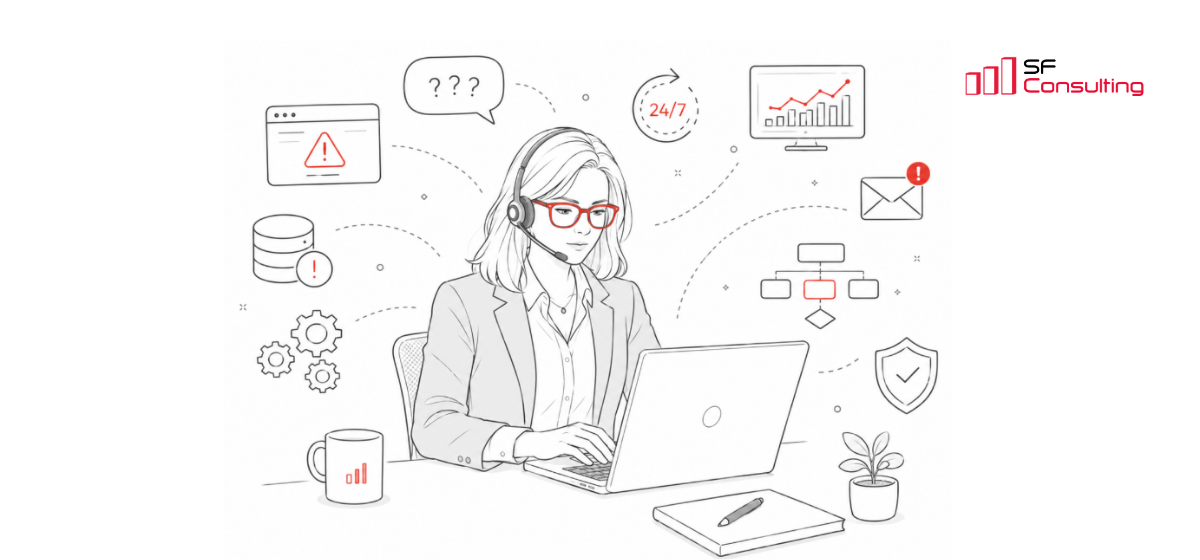
ERP support is not ticket processing
ERP support is often discussed through SLAs, ticket queues, and response times. But in real ERP environments, those metrics stop mattering very quickly when warehouse operations stop, invoices are missing, or production planning breaks in the middle of the day.
After many years supporting AX 2012 and Dynamics 365 Finance & Operations environments, we’ve learned that good ERP support has very little to do with formal ticket processing alone. In practice, support teams operate somewhere between technical troubleshooting, business operations, integrations, release management, monitoring, user communication, and organizational coordination.
Most serious ERP incidents are never isolated technical problems for very long. A failed integration quickly becomes a warehouse issue. A blocked batch job turns into delayed invoicing. A deployment problem becomes a finance escalation during month-end closing. In such situations, clients rarely care which technical component failed first. What matters is how quickly operational stability can be restored.
ERP support is ultimately measured by operational continuity, not by SLA statistics.
That is why effective ERP support usually depends less on formal support structures and much more on experienced engineers, proactive monitoring, long-term system knowledge, and close collaboration between technical teams and business stakeholders.
This article summarizes several practical lessons we’ve learned over the years about what ERP support for AX 2012 and D365FO should actually look like in real business environments.
Resolution instead of escalation
In ERP support, the real problem is rarely the incident itself. The real problem is how long users are forced to work around it. Sometimes delays are measured in hours of downtime and financial losses. Sometimes they are measured in months of manual workarounds, broken processes, and users adapting their work around unresolved system limitations.
In business-critical ERP support, ownership matters more than routing.
Traditional first-, second-, and third-line structures may work for standardized IT operations, but they often slow down ERP incident resolution when the issue requires immediate technical analysis and understanding of the business context.
In large organizations, we sometimes see critical ERP incidents reaching technical specialists only after days of emails, status meetings, escalations, and growing pressure from dozens of stakeholders trying to track the situation instead of resolving it.
In practice, effective ERP support usually requires direct technical ownership. A dedicated senior engineer or technical lead should know the client environment, integrations, business processes, and historical system behavior well enough to take responsibility for resolving issues. When necessary, business users and internal IT teams should be able to communicate directly with technical specialists without unnecessary intermediaries or escalation chains.
That’s one of the reasons why we intentionally keep our support organization compact and engineering-focused. At the same time, strong technical ownership only works when combined with operational transparency: regular status discussions, prioritization, risk visibility, and clear ownership help clients make better operational decisions around the ERP landscape.
ERP incidents don’t follow working hours
Anyone who has worked with ERP systems long enough knows that critical incidents don’t follow working hours. Failed overnight processing, blocked financial batches, stopped warehouse operations, or broken integrations often happen exactly when key technical specialists are offline.
Some of the most serious incidents we’ve seen started from routine overnight jobs that initially looked harmless.
ERP support needs resilience inside the engineering team, not only availability on paper.
A specialist may not always be immediately online, but experienced engineers must be able to support each other under pressure, guide recovery actions, and continue analysis when critical jobs, integrations, or warehouse processes fail outside normal working hours.
Over the years, we’ve found that this type of collaboration between senior technical specialists is often far more effective than rigid formal escalation models.
Technical generalists
Real ERP incidents rarely stay within a single technical domain. A warehouse issue may involve integrations, SQL blocking, batch execution, customizations, infrastructure behavior, and business process logic at the same time. What starts as a simple operational problem often spreads quickly across multiple dependent processes and system layers.
ERP support requires engineers who can think across system boundaries.
Serious incidents rarely remain isolated inside a single technical layer. Infrastructure, integrations, customizations, database behavior, and business processes often become tightly connected during operational failures.
Effective ERP support therefore depends not only on individual expertise, but also on close collaboration, shared understanding of the client environment, and a common motivation to solve problems together instead of separating responsibilities too strictly.
At the same time, collaboration can’t fully replace deep expertise. We’ve seen support models where almost every incident involved five or more people simply because nobody had enough ownership over specific technical areas. Instead of accelerating resolution, such setups often create additional coordination overhead and slow decision-making during critical situations.
That’s why this type of support is difficult to scale inside large-volume organizations built around narrow specialization and formal ticket routing. Effective ERP support still depends heavily on experienced engineers with broad technical knowledge, operational awareness, and deep understanding of the client environment.
Proactive monitoring
One of the most common mistakes in ERP support is treating monitoring as a purely technical activity.
In many ERP environments, technical problems become visible long before users start reporting them. By the time business users notice the issue, the system may already have been degrading silently for hours: growing SQL pressure, blocked batch queues, unstable integrations, deadlocks, failed batch jobs, or performance degradation after deployments.
Monitoring only becomes valuable when somebody is responsible for analyzing the signals, understanding the business impact, and reacting before users start opening incidents themselves.
ERP support depends on engineers who are ready to investigate problems proactively, understand their operational impact, and react before issues start affecting business users directly. In practice, proactive monitoring works best when both sides stay actively involved: experienced support engineers on the vendor side and responsible operational stakeholders on the client side who participate in incident analysis, prioritization, and operational decision-making together with the support team.
Depending on the environment, support teams typically combine platform monitoring, SQL diagnostics, integration tracking, and custom operational analysis tools. In our own support practice, this includes Azure Monitoring, Application Insights, Zabbix, SQL diagnostics, and specialized diagnostics for both AX 2012 and D365FO environments.
Proactive monitoring
A warehouse process may fail because operational teams changed procedures without informing IT. A security restriction may block finance users after infrastructure updates. A deployment issue may become critical because responsibilities between DevOps, developers, and business owners were never clearly defined. Sometimes incidents remain unresolved for weeks not because they are technically difficult, but because nobody understands which department owns the budget, who should approve the changes, or who is responsible for decision-making.
Many ERP incidents look technical on the surface, while the actual root cause is organizational.
In long-running ERP environments, technical issues become tightly connected with business processes, organizational structure, security policies, infrastructure management, release procedures, and coordination between departments.
Many companies try to solve this through additional support managers and coordination layers. Sometimes this helps. Sometimes it only creates more meetings, emails, and status discussions between people who still don’t fully understand the actual problem.
Because of this, long-term ERP support engineers often become the bridge between business users, developers, infrastructure teams, security specialists, and management stakeholders simply because they understand how different parts of the environment interact with each other.
After working with the same client for a long time, support engineers usually accumulate a large amount of operational context: understanding internal processes, knowing who makes decisions in different departments, remembering historical system changes, and recognizing organizational dependencies that later become critical during incidents, upgrades, audits, or major system changes.
Long-term ownership
Most companies try to maintain documentation, knowledge bases, and clear ownership structures. In reality, however, key employees leave, implementations pass through multiple vendors, and documentation quickly becomes outdated.
We have clients where our engineers gradually became one of the main sources of operational and technical knowledge about the ERP landscape simply because we’ve supported the environment continuously for many years.
This becomes especially visible during major incidents, migrations, audits, or staff turnover. We once had a situation where our support specialists communicated directly with external auditors because nobody inside the organization still fully understood how historical inventory-costing processes had been implemented years earlier.
Long-term ERP support becomes part of the client’s operational memory.
A stable support team accumulates knowledge about historical decisions, business exceptions, ownership structures, and system behavior that may no longer be fully documented inside the client organization.
Support should become more efficient over time
Recurring incidents should gradually disappear, communication should become faster, monitoring should improve, and engineers should spend less time rediscovering how the environment behaves.
Good ERP support should become more efficient every year.
Strong support teams gradually spend less effort reacting to incidents and more effort systematically eliminating the root causes behind them.
If the same incidents continue repeating for years, new specialists constantly ask the same questions, and diagnosis time never decreases, then the support model is not improving operational stability — it is only processing tickets.
Unfortunately, this is common in large support organizations built around staff rotation and support models focused only on formal SLA metrics. Knowledge gets lost, engineers change, and the client repeatedly pays for analysis of problems that should already be well understood.
Long-term ERP support should work differently. As the support team gains deeper understanding of the environment, historical issues, and operational specifics, incident resolution becomes faster, recurring problems require less analysis, and overall support costs should gradually decrease instead of constantly resetting with every team change.
Support pricing should reflect operational responsibility
One issue may take minutes to resolve, while another may stop master planning, delay invoicing, or disrupt warehouse operations for an entire day.
ERP support pricing should reflect operational responsibility, not ticket volume.
Reactive and proactive support models are fundamentally different.
Reactive support focuses on resolving reported incidents. Proactive support includes continuous monitoring, preventive analysis, release coordination, operational communication, and reducing risks before users notice visible problems.
A large portion of ERP support work also exists outside formal ticket queues.
Senior support engineers spend significant time discussing process changes with key users, validating business assumptions behind requests, reviewing upcoming releases, coordinating with infrastructure and development teams, identifying operational risks, and helping clients avoid decisions that may destabilize the environment later.
This operational context is accumulated gradually over time and becomes one of the most valuable parts of long-term ERP support.
From our experience, the most effective commercial model is fixed monthly support capacity combined with separate estimation for larger projects, major releases, or exceptional activities outside normal operational support.
This model provides stable operational ownership and predictable support costs, while giving clients full visibility and budget control over larger enhancements and transformation activities.
We keep this model economically sustainable through a compact engineering-driven organization, nearshore delivery, and continuous internal training. This allows us to provide senior Dynamics 365 and AX expertise without the heavy management overhead often found in large international support structures.
Summary
Good ERP support is often invisible to management when it works properly. Users communicate directly with engineers, critical processes continue operating normally, and incidents are resolved before they become business disruptions.
One experienced IT manager once said: “If I know the full name of the support engineer, something is probably wrong with the support partner”.
In mature ERP environments, the best support organizations are usually the least visible ones because operational stability becomes part of the normal business routine.

Keep up to date with new articles before anyone else, subscribe to our mailing list
Table of Contents





Thank you for the request!
We will get back to you soon.